{loo-loo-run}

Thanks for visiting! This blog posts regular news, info, and recipes about Javanese lulur and other indonesian traditional body care. Go ahead, subscribe to our posts! Enter your email address:

(after subscribe pls check your inbox for confirmation)

Delivered by FeedBurner

Google
 

Javanese Bride and Groom

>> Sunday, October 18, 2009

gambar dari mudah menikah
dari weddingku
dari deteksi99

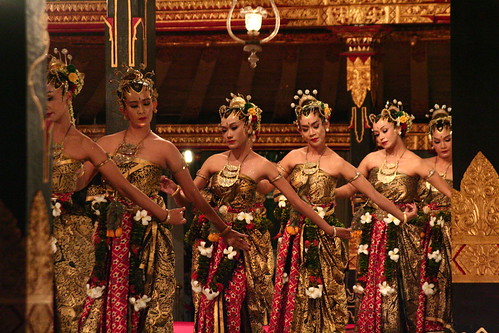
Pictures of Javanese bride and groom. In the traditional wedding ala Mataram court there are several ceremony such as lamaran, pasang tarub, tuwuhan siraman, ijab kabul, panggih, resepsi, sepasaran and selapanan. Normaly it takes four to five hours to prepare the bride make up and clothes. The bride have a paes pinanganten or wedding forehead painting in their front hair line. We can see that the javanese is not realy a body conscious people.

Read more...

Wayang kulit, the Javanese Shadow puppet

>> Thursday, February 19, 2009

pic from kkseema
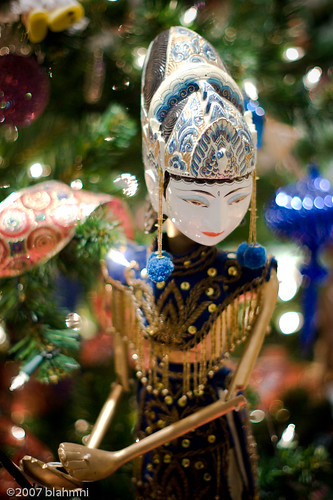
The puppet made from cow, buffalo or goat's skin which processed, engraved and painted until done. The puppet then played for a wayang kulit show, usually Ramayana or Mahabharata stories. It needs at least 18 people to play a complete shaddow puppet show, one puppet master or dalang, 2 singers and 15 peoples to play music instruments, the gamelan. The show can be up to 8 hours. The stage contains white fabric as a screen with banana tree pole lay down below for sticking all the puppets. The traditional lamp is a brass coconut oil lamp (blencong), but nowadays a halogen lamp will do. The audience watch from behind the white fabrics, only watch the shadow of the ornamental puppet.
This blog ki-demang (sorry, it's in Javenese!) and warta pepadi is a complete resource for more wayang kulit infos.

pic from micro.cosmic

fragment of Dewi Sri Boyong (Bring Dewi Sri) by Ki Manteb Sudarsono


this one is a shadow video with subtitles

Read more...

BATIK: Indonesian Art of Textile

>> Saturday, October 4, 2008

pic from trulyjogja

Batik refers to textile that dyed several times with a specific technique called batik. Although the process of decorating cloth through the process of batik is found in several regions in Africa or India and even in some South East Asian countries, the batik of Indonesia is unique and unequaled. Batik is generally thought of as the most quintessentially Indonesian textile. Indonesian Batik is made in several regions, but the center of the art is Central Java, in cities like Yogyakarta, Solo, Cirebon, Pekalongan and Indramayu.

Motifs of flowers, twinning plants, leaves buds, flowers, birds, butterflies, fish, insects and geometric forms are rich in symbolic association and variety; there are about three thousand recorded batik patterns. Batik motifs recall characters from the Hindu epics, plants, animals, sea creatures and gamelan melodies.

pic from serve.com/aberges

In the 19th century, the application of waxed patterns with a large copper stamp or stenciled saved the batik industry from competition with cheap printed European cloth. The semi-industrial nature of stenciled work allows it to be performed by men. Stenciled batik is much cheaper than hand made. Stenciled usually produced by men while hand made batik usually made by women. So based on the process there are 2 types of batik, hand written batik (batik tulis) and stenciled batik (batik cap).
pic from gavirosenthal

The art of "batiking" is similar to the one of drawing or painting on a piece of cloth. The main tool - the canting (read:tjahn-thing)- is a small copper container with a long slender spout, is used instead of a pencil or brush, and liquid wax instead of paint.
pic from murnis

Finely detailed designs are first drawn freehand with a pencil on the textile. Then hot liquid wax is applied. From time to time the tip of the canting must be blown to secure an easy flow of the wax. Areas not slated for coloring are filed with the wax.
pic from trulyjogja

The cloth is then passed through a vat of dye. The wax is removed with hot water, scraped from the portions of the dried material still to be dyed. The parts that were covered by the wax did not absorb the dye and thus remain white (or whatever color the original cloth was previously dyied). Since the wax behave as a resisting medium, this process is called resist-dye process.
Next, other areas are waxed over. this is repeated during each phase of the coloring process, up to four or more times, until the overall pattern and effect are achieved.

pic from tjokrosuharto


A traditional recipe for batik wax is a mix of beeswax and paraffin, about 60:40. Beeswax is soft, pliable, and blocks completely: no cracking. Paraffin is more brittle, and lets dye penetrate wherever cracks form. Crackle is a characteristic batik effect, a scatter of thin dark wavy lines, a batik hallmark. Some dyers seek crackle, freezing and crumpling the cloth to make more. Others avoid, if they can, any effect that seems uncontrolled. For more crackle, more paraffin. Any clean, low-oil paraffin, melting from 130 - 150° F will work. Beeswax should be light yellow or tan and clear of debris. But most batik today is done with synthetic micro-crystalline waxes. They’re more consistent, more often reusable, penetrate better, can be heated (safely) to higher temperatures. They usually fall between beeswax and paraffin in price and in working properties. They can be blended with other waxes for intermediate effects.
Article source discover-indo
Klick here to know more about batik at Pekalongan batik museum.
This web have a complete story of Yogyakartan batik.

Today batik is not only applied in fabrics but also for wooden crafts like this mask below.
pic from baliartwares

Old picture of women wears batik and kebaya
pic from indonesiamedia

Modern batik inspired dress
pic from planet

Read more...

Madura's Magic Wand

>> Friday, September 19, 2008

Tongkat Madura (Madura's stick) is a secret maduranese women for a more sex-enjoyable vagina. This stick made from limestone, manjakani, rapet wood (Parameriae cortex), jati belanda leaves (Guazumae folia) and others. How to use: put the stick into vagina, leave it for 2 minutes and pull off. Wash the stick for next use. The purpose: to make the vjj drier for more enjoyable sex, nicer odor and cures fluor albus.

this Madura's stick unfortunately made in China

Drier vagina is preferable for Javanese and Indonesian women, believing the myth that drier vagina is more enjoyable for men because the drier it is the smaller and tighter it will be, just like a virgin. The article here spotted the myth from medical point of view, how women effort to make their vjj drier can lead them to a more vulnerable cervic and even dangerous for their health.

Read more...

JAMU GENDONG

>> Wednesday, September 17, 2008

the jamu lady in this picture still owe me 3 kgs of temugiring and go MIA

Jamu gendong means back carried jamu. This traditional lady vendors sell various jamus such as beras kencur (for fatigue and good appetite), kunir asam (for womans health), cabe puyang (for fatigue and pain), pahitan (for 'sweet blood' or diabetes), kunci suruh (for vagina's health), kudu laos (for better blood flows), and uyup-uyup/gepyokan (for better breast milk flows).
This jamus stored in the glass bottles and served in glass portion. Today they also sell 'modern' jamus in pills and powders and other traditional beauty stuffs such as lulur and ratus. For more information about jamu gendong click here

Read more...

RICE

>> Tuesday, May 27, 2008

pic from intaniasalsa

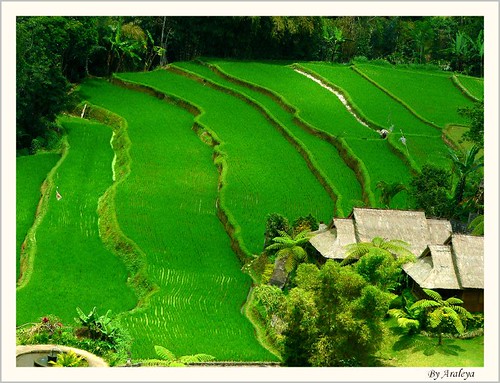
Rice (Oryza sativa)is the main food for Javanese and most indonesians (drier eastern indonesia have sagu and sweet potatoes). Lots of rituals and traditions here actually made for rice worshipment, so it is called that we have a rice culture.

The term 'rice' if translated to bahasa indonesia have a pretty long list depends on its state. The rice plant is padi (paddy) and grown in the watered field (sawah). The grain is gabah, which is rice with palea/skin. After the skin peeled (in ancient time we hammered it with alu and lesung) it become beras (raw rice grain). After cooked/steamed we called it nasi.


The rice goddes is Dewi Sri, fertility symbol, and lots of rituals and offerings are made for her.

pic from kaskus

Traditional tool to pick rice while harvesting is ani-ani.

pic from
seasite

There are so many types of rice: white, red, black, glutenous, aromatic, dry, moist, smaller grains, bigger grains. Besides nasi, rice can be cook in many different ways. After milled it became tepung beras (rice flour) to make traditional cakes, chips, wrap in leaves and so on. And we havent talk the rice rules for beauty regime, yet.

Read more...

Javanese post-natal treatment

>> Wednesday, May 14, 2008

Javanese women have their secret for post natal body treatment. 7 days after the delivery they put tapel (tah-pehl), mixture of slaked limestone, lime juice, betel leaf and cajuput oil on their stomach. Afterwards, bengkung (behng-koong), cotton wrap of 15 cm wide and 10 meters long binded tightly around the tummy (below breast to hip area). The binder sits there all day, and taking off in the afternoon for a hot shower to cleanse. This treatment repeat daily for 40 days.


Pilis (peelees) is a forehead mask for relieving head ache and restore vision. Parem (pah-reamp) is a water based lotion of rice, ginger and pepper to warms legs and arms and ease the blood circulation. With all the treatment mom’s body will back to initial shape very soon as it is before pregnancy and have a good overall health. Indonesian jamu manufacturers such Nyonya Meneer, Jamu Iboe and Simona have a complete post natal jamus package for no fuss home treatment.

Read more...

Tuberose

>> Saturday, May 10, 2008

Tuberose Polianthes tuberosa L (Sedap Malam, or Night Delicious - because the scents spread heavily at night) is native to Central America. The fragrance is strong, mysterious and seductive and Indonesians usually asociated the scents with female spirits/ghosts. It’s very popular in Indonesia as cut flowers or clustered for bride’s accessories and decoration, traditional rituals and ceremonies. Other type of tuberose flowers is edible and added to kimlo soup.


Tuberose oil is very expensive. This probably because the flower itself have a very good economic value as cut flowers, or maybe because the production process is not widely known. Unlike other essential oils, tuberose oil processed from extraction of fresh flowers, picked before the petals open and mixed with usually hexane solvent.
Tuberose oil is not normally used in aromatherapy but widely used in the perfume industry as a component of good quality perfumes and is said to have narcotic properties, although proper safety data is not available.

Read more...

Fresh jamu drinks at Toko You

>> Sunday, April 20, 2008

If you want to try fresh jamu drinks while in Bandung, just go to Toko You, a cafe/diner situated at jalan Hasanuddin, Dago area, just near the Borromeus Hospital.
Beside its cozy ‘warung’ like ambience (warung is a traditional grocery stall) and their butter fried frogs, we can have fresh jamu drinks. At the jamu bar we can order jamu drinks while watching the production process. Theres a lot of fresh tubers and other jamu ingredients inside the big jars on the table.


We can order any jamu drinks including beras kencur (rice and lesser galangan), kunyit asem (turmeric and tamarind), jamu sehat (health tonic) and so on. Just sip the jamu as a refreshment drink, or after meal whatever you like. You can ask it to be hot or cold. They sell jamu in bottles also for take away, no preservatives guaranteed.

Read more...

stone scrubing

>> Tuesday, March 18, 2008

As i was mention in older post about lulur, the lulur rituals originally performed by royal ladies inside the javanese courts. But ordinary girls outside also have their own way to keep their skin smooth. Theres always the stone.

Small stone from the river, picked carefully by size and smoothness. The shape should be round and the surface suppose to be smooth, with or without pores. Pumice also suitable for this, but have a rougher quality. The next step just rub the stone to skin tenderly while in the shower, and there it is, a scrub in its very basic form.

Read more...

  © Blogger template Inspiration by Ourblogtemplates.com 2008

Back to TOP